Hybrid Nanoparticles: A New Route for siRNA Delivery in Cancer Therapy
Key takeaway: Hybrid lipid-polymeric nanoparticles can reach cancer cells more reliably through two mechanisms — passive targeting (the EPR effect, exploiting leaky tumor vessels) and active targeting (ligand binding to receptors such as IGF-1R) — though the EPR effect is not a fixed, guaranteed phenomenon in humans.
This article is educational and does not replace a physician's diagnosis or treatment advice.
Why does chemotherapy need targeted delivery?
Chemotherapy remains a cornerstone of cancer treatment, but many anticancer drugs cannot fully distinguish tumor cells from healthy ones. As a result, tissues with rapidly dividing cells — hair follicles, bone marrow, the digestive tract — can be affected. Hair loss, nausea, and reduced blood cell counts are well-known side effects of some chemotherapy drugs.
Pharmaceutical nanotechnology was developed partly to address this problem. In this approach, a drug or genetic material is loaded into a very small carrier to increase its stability in the body, control its release, and improve the likelihood it reaches the intended tissue.
What is a drug-carrier nanoparticle?
A drug-carrier nanoparticle is typically a nanoscale structure capable of carrying a drug, protein, or genetic material through the bloodstream. Many systems studied in oncology fall roughly in the 10–200 nanometer range; the ideal size, however, depends on the carrier type, administration route, tumor characteristics, and therapeutic goal.
Two major material classes are used in these systems:
- Lipids, as in lipid nanoparticles.
- Biodegradable, biocompatible polymers such as those from the polycaprolactone (PCL) family.
Hybrid lipid-polymeric systems aim to combine the strengths of both: the polymer component can improve stability and control release, while the lipid component can improve compatibility with the cell membrane and cellular uptake.
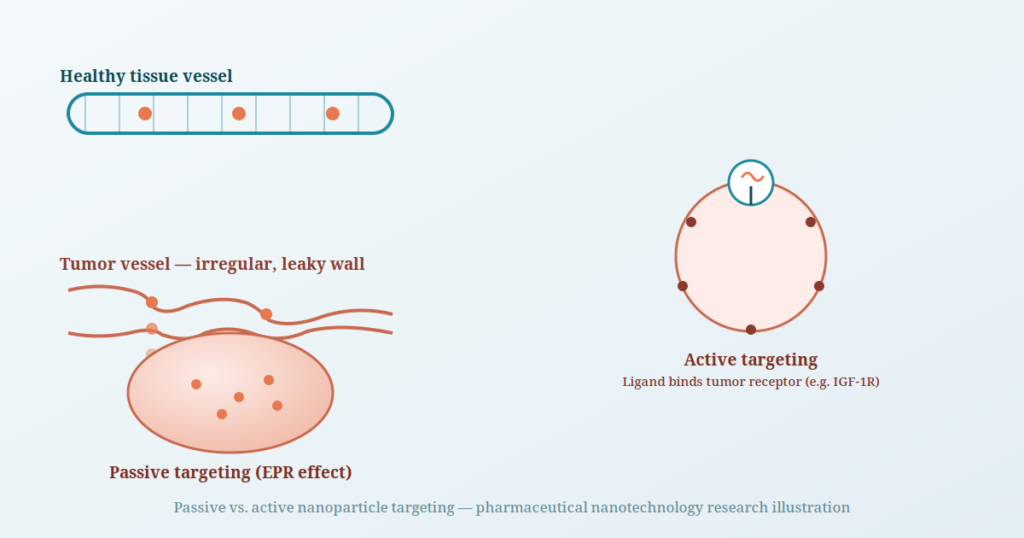
How is tumor targeting achieved?
Nanoparticle targeting is generally studied in two main forms: passive targeting and active targeting.
Passive targeting and the EPR effect
Tumors often have irregular blood vessels and a complex interstitial environment. These features can allow some nanoparticles to leave the vessel and accumulate in tumor tissue in certain tumors — a phenomenon known as the Enhanced Permeability and Retention (EPR) effect.
However, the EPR effect in humans is not a fixed, uniform phenomenon. Tumor type, size and stage, blood supply, interstitial pressure, extracellular matrix density, and immune status can all change how much nanoparticle accumulates. This is why promising results in animal models don't always translate to the same degree in patients.
It's more accurate to think of EPR as a condition-dependent biological capacity rather than a guaranteed way to deliver a nanoparticle to every tumor.
Active targeting
In active targeting, molecules such as antibodies, peptides, or ligands are attached to the nanoparticle surface. These molecules can interact with receptors overexpressed on some cancer cells' surfaces. HER2 and IGF-1R are among the receptors studied in breast cancer research.
Active targeting may increase binding and cellular uptake, but its success depends on receptor density, nanoparticle access to the cell, tumor microenvironment characteristics, and binding stability. A ligand on a nanoparticle's surface alone, therefore, doesn't guarantee complete, specific targeting.
How does siRNA help silence a gene?
Small interfering RNA (siRNA) is a short RNA fragment that can reduce the expression of a specific gene. When properly designed, siRNA binds to the target messenger RNA and prevents production of the corresponding protein.
This mechanism matters for cancer because some genes are involved in tumor cell growth, proliferation, migration, or resistance. Silencing such genes can reduce the biological pathways associated with tumor progression.
However, naked siRNA has significant problems:
- It is rapidly degraded in the bloodstream.
- It may be cleared from the body before reaching the target cell.
- On its own, it does not cross the cell membrane efficiently.
- It may distribute to unrelated tissues or trigger an immune response.
Lipid and hybrid lipid-polymeric nanoparticles can reduce some of these barriers by protecting siRNA, increasing its stability, and helping it enter the cell.
IGF-1R and breast cancer
IGF-1R is a receptor involved in cell growth and survival pathways and has drawn attention in breast cancer research. Some studies have examined siRNA delivery against IGF-1R using hybrid nanoparticles in breast cancer cell lines, reporting reduced IGF-1R expression and changes in some indicators associated with cancer cell behavior.
These results are scientifically important, but a distinction must be made between "reduced gene expression in a cell or lab model" and "effective cancer treatment in humans." Reaching clinical application requires such systems to pass through extensive stages of toxicity evaluation, biodistribution, safety, appropriate dosing, standardized manufacturing, and clinical trials.
Challenges on the path to the clinic
Nanoparticle-based therapies have not yet become a routine replacement for surgery, radiation, or chemotherapy. The main challenges in this field include:
- Formulation stability during storage and transport.
- Control of nanoparticle size, surface charge, and composition.
- Clearance of nanoparticles by the liver, spleen, or immune system.
- Delivering a sufficient amount of siRNA to tumor cells.
- Releasing siRNA at the right time and location.
- Differences between animal models and human tumors.
- Uniform, reproducible manufacturing at industrial scale.
- Long-term toxicity evaluation and the potential for immune responses.
One major challenge is the gap between a formulation's performance in the lab and its performance in the human body. Even if a nanoparticle enters breast or colon cancer cells well in a cell line, factors such as blood proteins, the immune system, blood flow, and tumor architecture can change the outcome.
Research outlook
Hybrid lipid-polymeric nanoparticles can serve as a platform combining several capabilities: protecting siRNA, controlling release, improving cellular uptake, and allowing targeting molecules to be added. The future of this technology, however, depends on more precise design, better patient selection, deeper understanding of tumor biology, and controllable manufacturing.
This technology could replace existing treatments entirely in the not-too-distant future, and could also help with more targeted and combination therapies. In such an approach, the goal is not just to kill cancer cells – it also targets genetic pathways involved in growth, invasion and resistance to treatment.