INSF — Iran National Science Foundation
Precision Medicine & Nanotechnology
Personalized Cancer Treatment
Combining computational oncology biology models to simulate individual patient drug responses and optimize therapeutics.
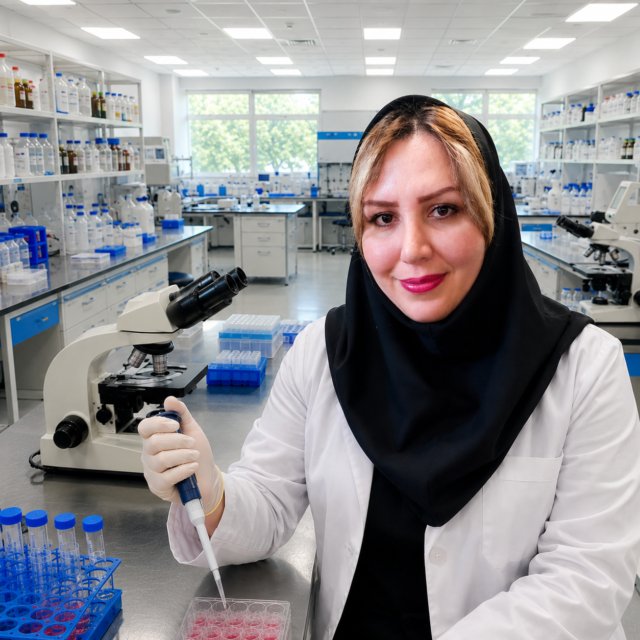
Leading Nanomedicine Researcher
Developing Advanced Nanocarriers for Target-Specific Cancer Therapeutics
Dr. Afsaneh Mennati is a researcher in Pharmaceutical Nanotechnology, specializing in the formulation of nanoparticles and target-specific siRNA delivery. Her cutting-edge research targets malignant breast cancer pathways, achieving gene silencing with minimized standard cytotoxic effects.
6+
ISI Publications
5+
Registered Protocols
siRNA Delivery
Lipid Nanoparticles (LNPs)
Breast Cancer Research
Hybrid Polymer Synthesis
Animated Biological Simulation
The Journey of a Tumor-Suppressor Gene Nanocarrier into Cancer Cells
An automated visualization of hybrid nanocarriers delivering tumor-suppressor genes and siRNA into cancer cells, silencing driver oncogenes across three engineered stages.
01
Polymer Core Formulation
Therapeutic siRNA chains are loaded into the biodegradable polymer core, surrounded by a lipid bilayer to prevent degradation in physiological fluids.
02
Active Receptor Targeting
Targeting ligands on the nanoparticle surface bind specifically to HER2 receptors overexpressed on breast cancer cells, triggering receptor-mediated endocytosis.
03
Oncogene Silencing & Apoptosis
Inside the cell, the carrier degrades, releasing siRNA to slice target oncogene mRNA. This terminates cell proliferation and induces cell apoptosis.
Research Methodology — Not a Clinical Service
Cancer treatment simulation process
Our lab's research framework for analyzing de-identified genomic datasets — obtained exclusively through formal academic collaborations and research-ethics approvals — and translating them into computational drug-delivery simulation models. This describes a research methodology, published in peer-reviewed literature, not a diagnostic or treatment service offered to patients.
Important: The following describes our lab's research methodology, conducted exclusively within academic collaborations using de-identified data and under research-ethics (IRB) approval. This page does not offer diagnostic services, treatment advice, or a substitute for a treating physician's judgment.
1
Research Genomic Dataset Acquisition
Under formal research collaboration agreements and IRB/ethics approval, de-identified genomic sequencing datasets are obtained from partner institutions and prepared for computational analysis.
2
Computational Simulation Modeling for Target Receptor Identification
Developing digital simulation models based on the molecular profiles within research datasets, to identify patterns of targetable receptors and driver oncogenes for scientific study.
3
Computational Analysis of Compound Efficacy & Synergy
Computationally evaluating the modeled therapeutic response of drug compounds and their combinatorial synergy against studied genetic patterns, as part of drug-resistance research projects — this analysis does not substitute for a treating physician's judgment or clinical decision-making.
4
Research Findings Dissemination
Results of computational simulations — including modeled oncogene-inhibition rates and theoretical compound efficacy — are disseminated through peer-reviewed publications and shared research reports with partner institutions.
Scientific Career & Research Background
The Scientific Journey of Dr. Afsaneh Mennati
2009 — Present
A curated overview of the academic trajectory, key discoveries, research projects and honors of Dr. Afsaneh Mennati in nanomedicine, siRNA gene therapy and personalized cancer biosimulation.
2022 — 2025
First Postdoctoral Researcher, Qazvin University of Medical Sciences (QUMS)
Leading the design of nanocarriers for targeted siRNA and tumor-suppressor gene delivery in aggressive breast cancer models.
Ph.D.
Ph.D. in Pharmaceutical Nanotechnology
Synthesis and optimization of mPEG-PCL/DDAB hybrid nanoparticles for co-delivery of siRNA and anti-cancer agents to MCF-7 breast cancer cells.
Breakthrough
World-First Silencing of > 90% of Breast-Cancer-Driver Genes
A novel anti-breast-cancer formulation that, for the first time worldwide, silenced more than 90% of the driver oncogenes involved in breast cancer.
Research Focus
Research in Genomics-Driven Personalized Cancer Therapy
Developing research frameworks for modeling drug efficacy based on genomic data — integrating computational cancer biology models for theoretical drug-response prediction, published through academic studies.
Publications
6+ ISI Publications in Q1 Journals
Published in International Journal of Biological Macromolecules, Journal of Drug Delivery Science and Technology, American Journal of Cancer Research and Advanced Pharmaceutical Bulletin.
Media & Impact
Featured by INSF, IRNA, ISNA & the Vice Presidency for Science & Technology
Interviews with national scientific outlets on smart nanocarriers engineered to halt cancer growth.
In the Media
Interviews & Press Coverage of Dr. Mennati’s Research
Selected national press coverage of Dr. Mennati’s breakthroughs in siRNA-based breast cancer nanotherapy and postdoctoral research.
IRNA — Islamic Republic News Agency
Iranian Researcher Develops World-First siRNA Nanocarrier for Targeted Breast Cancer Gene Silencing
Read Full Coverage →
ISNA — Iranian Students News Agency
Smart Nanocarriers to Halt Cancer Growth — Interview with Dr. Afsaneh Mennati
Read Full Coverage →
ISTI — Iran Vice Presidency for Science & Technology
Smart Nanocarriers for Stopping Cancer Growth — Vice Presidency for Science & Technology
Read Full Coverage →
Qazvin University of Medical Sciences (QUMS)
Dr. Afsaneh Mennati — First Postdoctoral Researcher at Qazvin University of Medical Sciences
Read Full Coverage →
Academic Footprint
View All Publications
Featured Publications
Scientific Paper
Dual silencing of integrin αvβ3 receptor and insulin-like growth factor 1 receptor using mPEG-PCL/DDAB hybrid nanoparticle loaded siRNA in breast cancer therapy: An in vitro study on MCF-7 cells
Mennati A, Rostamizadeh K, Fathi M (2024). Novel hybrid nanocarrier co-silencing integrin αvβ3 and IGF-1R for targeted MCF-7 breast cancer therapy.
Impact Factor:
8.7
Read Full Study →
Scientific Paper
Co-delivery of siRNA and lycopene encapsulated hybrid lipid nanoparticles for dual silencing of insulin-like growth factor 1 receptor in MCF-7 breast cancer cell line
Mennati A, Rostamizadeh K, Manjili HK, Fathi M, Danafar H (2022). Hybrid lipid nanoparticles co-deliver siRNA + lycopene to dual-silence IGF-1R in MCF-7 breast cancer cells.
Impact Factor:
8.7
Read Full Study →
Scientific Paper
Synthesis of methoxy poly(ethylene glycol)-poly(ε-caprolactone) diblock copolymers hybridized with DDAB cationic lipid as the efficient nanocarriers for in vitro delivery of lycopene into MCF-7 breast cancer cells
Mennati A et al. (2021). mPEG-PCL/DDAB hybrid nanocarriers for efficient intracellular lycopene delivery to MCF-7 breast cancer cells.
Impact Factor:
5.2
Read Full Study →
Auto-updated · Twice Daily
View All News →
Scientific News & Cancer Research Reports
ScienceDaily — Cancer Research
Vitamin C linked to fewer deaths in blood disorder trial
Vitamin C may do more than support the immune system. In a phase 2 trial of people with precancerous or…
ScienceDaily — Cancer ResearchScientists say house cats could help unlock better cancer treatments for humans
Scientists have mapped the genetics of cat cancer on an unprecedented scale and found surprising similarities with tumors in humans.…
ScienceDaily — Cancer ResearchA major risk of breast cancer screening may have been overestimated for decades
A new analysis suggests mammograms may lead to far less breast cancer overdiagnosis than some earlier studies indicated. Researchers reexamined…
ScienceDaily — Cancer ResearchCRISPR could help doctors attack blood cancer without destroying healthy cells
Researchers used CRISPR to remove CD33 from donor stem cells, potentially giving doctors a way to attack aggressive blood cancers…
ScienceDaily — Cancer ResearchThis new drug could break cancer’s resistance to treatment
A new experimental drug called CS18 may help break through cancer drug resistance by disabling several of the defenses tumors…
National Cancer Institute (NCI)NCI and CRUK Take on Cancer’s Toughest Problems
Cancer Grand Challenges brings together international, interdisciplinary teams to tackle problems no single scientist, institution, or country can solve alone.…
Scientific Collaboration
Get in Touch
For inquiries about computational biosimulation research, academic collaborations, or research mentoring.